Why Fluid Selection Defines Microfinishing Success
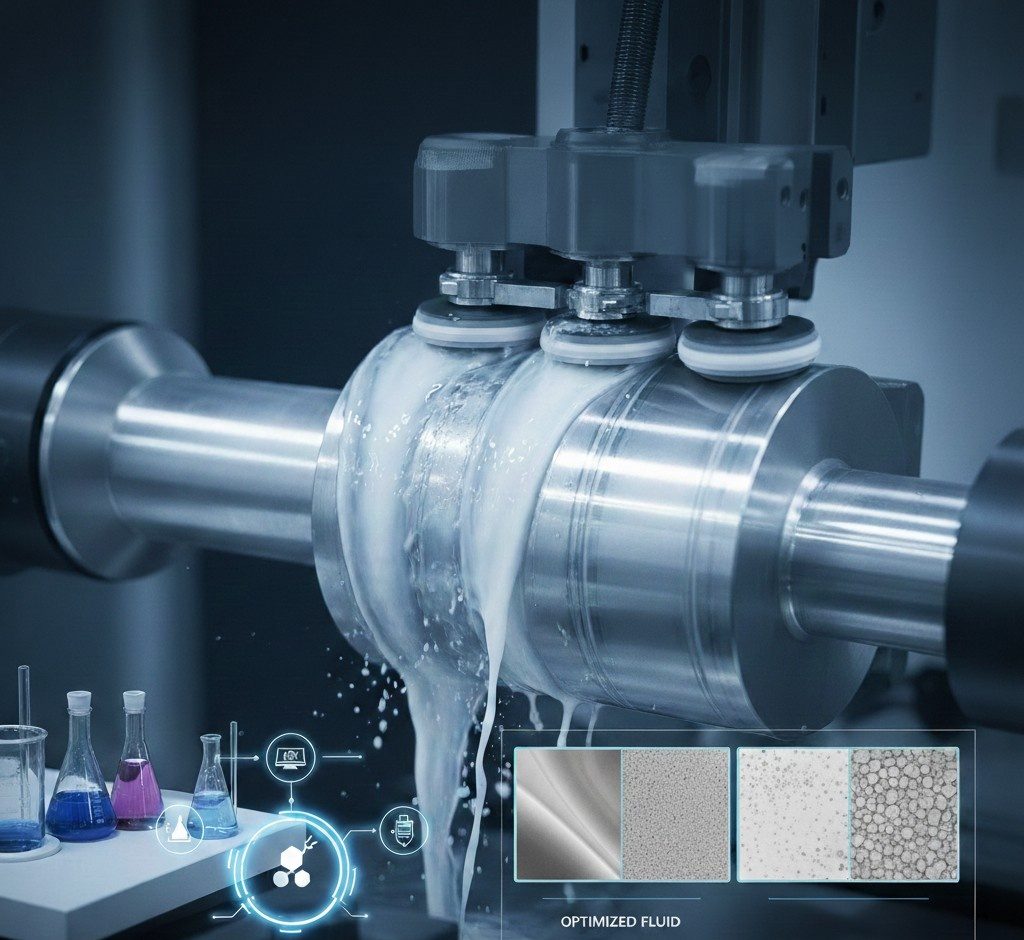
In microfinishing, surface quality is rarely defined by abrasives or machines alone. From our experience working with production floors, metallography labs, and R&D teams, fluid selection is often the deciding factor between consistent results and avoidable failures.
Microfinishing fluids are not passive consumables. They directly influence cutting behavior, heat generation, debris control, and final surface integrity. Yet many processes rely on familiar or convenient fluids rather than those matched to actual operating conditions. The result is surface damage, rework, and misleading inspection outcomes.
Whether refining critical components, preparing samples for analysis, or finishing additively manufactured metals, one principle holds true: no single fluid works for every application. Choosing fluids for microfinishing success requires aligning fluid properties with material type, pressure, speed, and performance goals.
Microfinishing Fluids
Microfinishing fluids fall into three primary categories, each playing a specific role in surface finishing and metallographic workflows.
Polishing Lubricants
Polishing lubricants reduce friction, manage heat, and protect the surface during material removal.
Key functions include:
- Reducing friction between the abrasive and the surface
- Providing cooling during high-energy contact
- Protecting surfaces under load
Film behavior is critical. Thin films increase heat and damage risk, while overly thick films reduce cutting efficiency. Residue characteristics also matter, as some lubricants interfere with inspection, coating, or downstream processing if not properly controlled.
Polishing Suspensions
Polishing suspensions act as carriers for abrasive particles, keeping them evenly distributed during finishing.
Performance depends on:
- Particle stability and resistance to settling
- Consistent abrasive delivery
- Compatibility with pads, cloths, and tooling
Poorly matched suspensions can cause uneven cutting, particle agglomeration, or contamination—especially in precision and metallographic polishing applications.
Polishing Media
Polishing media refers to the abrasive system itself, whether fixed or loose.
Key considerations include:
- Fixed versus loose abrasive formats
- Dependence on carrier fluids
- Media–fluid compatibility
Even high-quality media performs poorly when paired with the wrong fluid, making polishing media selection inseparable from fluid choice.
Lubricants, Suspensions & Media
Key Differences
Understanding when to use each fluid type is essential for process control.
Functional Differences in Cutting, Cooling, and Protection
- Polishing lubricants emphasize cooling and surface protection
- Polishing suspensions support controlled material removal
- Polishing media define the cutting mechanism
Each affects heat dissipation, cutting aggressiveness, and subsurface integrity in different ways.
Why “Multi-Use” Fluids Often Underperform
General-purpose products are frequently used outside their intended design. While marketed as versatile, they rarely deliver consistent microfinishing results.
Common problems include:
- Inconsistent film thickness
- Poor debris control
- Chemical incompatibility with certain materials
Products like WD-40 are often misapplied in microfinishing, leading to contamination and surface damage rather than protection.
Fluid Chemistry and Surface Integrity
Fluid chemistry plays a significant role in final surface quality.
Chemical Composition and Surface Interaction
The composition of microfinishing fluids affects:
- Residue formation
- Contamination risk
- Compatibility with metals, ceramics, and composites
Some fluids leave films that obscure defects or interfere with microscopy, while others react with sensitive alloys.
Downstream Effects on Inspection, Coating, and Testing
Incorrect fluid selection often creates issues beyond finishing:
- Interference with optical or electron microscopy
- Coating adhesion failures
- Increased cleaning effort
In many cases, the impact of polishing fluids becomes most visible during inspection rather than during the process itself.
Film Thickness, Viscosity & Flow
Film Thickness and Cutting Behavior
Film thickness controls the balance between protection and cutting efficiency:
- Thicker films reduce heat but slow material removal
- Thinner films increase cutting but raise damage risk
Consistent surface finishes depend on maintaining the correct film under operating pressure.
Viscosity Matching to Pressure and Speed
Viscosity must match process conditions:
- Low-speed, low-pressure processes allow more flexibility
- High-speed, tight-tolerance applications require precise control
Small mismatches can affect finish quality and dimensional accuracy.
Heat, Friction & Subsurface Damage
Thermal Stability and Cooling Performance
Microfinishing generates localized heat that can alter microstructure. Effective surface finishing fluids provide:
- Stable cooling performance
- Resistance to thermal breakdown
There is often a trade-off between short-acting fluids that require frequent reapplication and longer-lasting fluids that may attract debris.
Preventing Microcracks and Deformation
Fluid selection directly influences:
- Microcrack formation
- Smearing and plastic deformation
- Metallographic integrity
This is especially important in aerospace and automotive components.
Read: How Superfinishing Affects Product Quality in Manufacturing
Choosing Fluids by Material Type
Microfinishing Metals
Considerations include:
- Ferrous versus non-ferrous behavior
- Oxidation and corrosion risk
- Sensitivity to residue
Ceramics and Hard Materials
These materials require control over:
- Abrasive particle behavior
- Lubrication without excessive cushioning
Composites and Advanced Alloys
Chemical compatibility becomes critical due to mixed phases and coatings.
Additive Manufacturing (3D-Printed Metals)
Printed metals introduce challenges such as:
- Surface porosity
- Trapped residues
- Irregular microstructures
Fluid selection is especially important in post-print finishing workflows.
Water-Based vs. Oil-Based Fluids
Performance, Cleanliness & Environmental Trade-Offs
- Water-based fluids favor cleanliness and easy removal
- Oil-based fluids provide durability and lubrication under load
Residue behavior and storage stability vary widely between the two.
Application-Specific Recommendations
Lab environments often prioritize cleanliness and repeatability, while production settings focus on longevity and cost control.
How Polishing Media and Carrier Fluids Work Together
Matching Media to Fluid Properties
Properly matched systems support:
- Consistent cutting
- Uniform surface finishes
- Reduced rework
Process Optimization for Precision Finishing
Tight-tolerance components require coordinated control of:
- Media type
- Fluid chemistry
- Process parameters
Best Practices for Selecting Microfinishing Fluids
Key Selection Criteria
When selecting polishing fluids for microfinishing, evaluate:
- Material type
- Pressure and speed
- Tooling compatibility
- Cleanliness versus durability
Storage, Shelf Life & Fluid Interaction Risks
Fluids can change over time. Improper storage or cross-contamination often alters performance without obvious signs.
Lab-Scale vs. Production Microfinishing
Research, QC & Educational Environments
Priorities include:
- Repeatability
- Clean inspection surfaces
- Minimal analytical interference
Manufacturing & High-Volume Production
Focus areas include:
- Process consistency
- Fluid longevity
- Cost efficiency
Frequently Asked Questions
How do polishing fluids affect microfinishing results?
They control heat, debris behavior, cutting efficiency, and surface integrity.
What’s the difference between polishing lubricants and suspensions?
Lubricants manage friction and cooling, while suspensions deliver abrasives.
Can one fluid work across multiple materials?
Rarely. Most applications benefit from task-specific fluids.
How often should microfinishing fluids be replaced or reapplied?
This depends on durability, contamination rate, and process intensity.
Matching Fluids to Process Requirements
Microfinishing success depends on treating fluids as active process variables. By matching chemistry, viscosity, and performance to real operating conditions, teams can improve surface quality, reduce defects, and achieve consistent results—without relying on product labels alone.
Explore the Right Fluid Strategy
At Psi dragon, we work with engineers, labs, and manufacturers to evaluate microfinishing challenges and identify fluid strategies that align with real-world requirements. If you’re exploring ways to improve polishing performance, a technical discussion is often the right place to begin.