
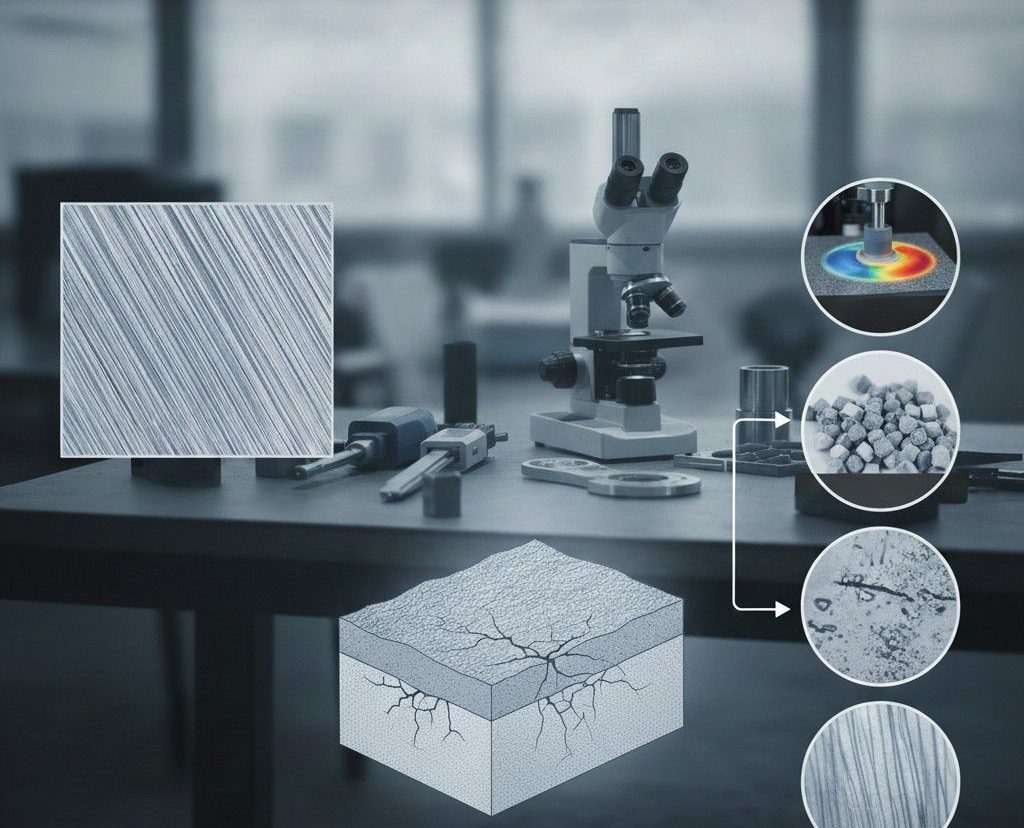
In metal finishing and materials testing, surface quality is often reduced to a single metric. Ra values are measured, reported, and approved—but in real-world applications, we routinely see parts with acceptable roughness numbers fail far earlier than expected. The disconnect lies in how abrasive grit size and fatigue life are actually related through tribology, subsurface damage, and the abrasive carrier itself.
Across production environments, testing labs, and R&D settings, performance depends less on how smooth a surface appears and more on how that surface was created. Below, we explain what truly drives wear, friction, and fatigue behavior—and how teams can make more reliable finishing decisions.
Why Abrasive Particle Size Matters More Than Surface Roughness
The relationship between surface roughness vs fatigue life is frequently misunderstood. Two components can display identical Ra values yet perform very differently under cyclic loading.
In practice, we observe:
- Identical Ra values hiding very different subsurface conditions
Aggressive abrasives can plastically deform material beneath the surface while still producing low roughness readings. - Fatigue degradation driven by surface condition, not bulk material strength
Fatigue cracks almost always initiate at or just below the surface. - The misconception that “below yield stress means infinite life”
Even low stresses can propagate cracks when surface integrity is compromised.
Ra describes surface texture—it does not predict fatigue performance. Understanding abrasive particle size effects is critical for realistic life assessment.
Understanding Tribology and Fatigue at the Surface Level
Tribology and fatigue are governed by what happens at the surface, where friction, wear, and contact stresses interact repeatedly over time.
Tribology Basics — Friction, Wear, and Contact Mechanics
The grit size effect on wear and friction depends on more than particle size alone. Key factors include:
- Abrasive sharpness and size distribution
- Contact pressure and sliding direction
- Directional scratches that dominate tribological behavior
- Abrasive carrier effects on surface finish, particularly cutting versus smearing
Compliant carriers may reduce visible scratch depth but often increase smearing and subsurface deformation, altering friction and wear behavior in service.
Fatigue Life Begins at the Surface
Fatigue failure is controlled by crack initiation—not by tensile strength.
Key realities include:
- Abrasive grit size directly influences crack initiation risk
- Roughness measurements alone do not predict fatigue life
- Confusion between fatigue, creep, and elastic behavior leads to false assumptions
This is why abrasive finishing and fatigue performance must always be evaluated together.
How Abrasive Grit Size Affects Fatigue Life
To understand how abrasive grit size affects fatigue life, it’s necessary to look beyond surface appearance and focus on deformation mechanisms.
Coarse Grits — Aggressive Cutting and Subsurface Damage
Coarse abrasives remove material efficiently, but they introduce risks:
- Plastic deformation beneath the surface
- Residual tensile stresses
- Stress concentrators that accelerate crack initiation
Processes such as grinding, grit blasting, and aggressive polishing can leave subsurface damage that finer steps may not fully remove.
Fine Grits — When Smoother Becomes Riskier
Finer finishes are not automatically safer.
Common issues include:
- Over-polishing and embedded abrasive particles
- Smearing that conceals underlying damage
- Reduced fatigue life despite improved visual appearance
In some alloys, excessively fine polishing alters near-surface microstructure in ways that negatively affect fatigue resistance.
The Critical Role of Abrasive Carrier Media
Grit size alone does not define performance. Abrasive carrier effects on surface finish are equally important.
Films, Cloths, and Papers — Controlled vs Compliant Cutting
Fixed abrasives typically provide:
- Better control over scratch direction
- More consistent material removal
- Reduced operator-to-operator variability
Flexible carriers introduce compliance, which can reduce scratch depth but often increases deformation and inconsistency.
Slurries and Suspensions — Polishing vs Material Removal
Slurries and suspensions are widely used in metallographic polishing abrasives, but they introduce challenges:
- Embedded particles remaining after polishing
- Residual surface damage that passes inspection
- Measurement tools failing to detect subsurface issues
Managing the transition from cutting to polishing is essential.
Fixed Abrasives vs Free Abrasives
- Fixed abrasives offer consistency and repeatability
- Free abrasives offer adaptability but increase variability
For production and R&D environments, repeatability is often the deciding factor.
Subsurface Damage
Subsurface damage from polishing and its effect on fatigue is one of the most overlooked contributors to premature failure.
Even when surfaces appear flawless:
- Deformation may exist well below the visible surface
- Crack nucleation can occur beneath acceptable finishes
- Identical Ra values can produce dramatically different fatigue lives
A cosmetic finish does not guarantee structural integrity.
Polishing Progression and Process Control
Process discipline is as important as abrasive selection.
Why Grit Progression Matters
Improper progression leads to:
- Residual damage that fine polishing cannot remove
- Inconsistent fatigue results
- Poor repeatability across operators or facilities
A controlled, stepwise progression is essential for maintaining surface integrity in metal finishing.
Avoiding Over-Polishing and Process Creep
Common problems include:
- Unnecessary extra passes
- Extended dwell times
- Better-looking surfaces that perform worse under fatigue loading
More polishing does not always mean better performance.
Measurement Limitations
The gap between surface roughness vs fatigue life in metals is amplified by inspection limitations.
- Stylus profilometers cannot detect subsurface deformation
- Optical systems miss embedded damage
- Existing standards often lag behind performance requirements
Passing inspection does not ensure fatigue durability.
Translating Lab Findings to Production Environments
Applying abrasive finishing impact on tribology and wear at scale requires balance.
Key considerations include:
- Unique surface challenges in additive manufacturing
- Trade-offs between throughput and fatigue performance
- Cost control without sacrificing reliability
Laboratory insights only matter when they translate into consistent production outcomes.
Key Takeaways for Engineers, Labs, and Manufacturers
- Abrasive particle size and carrier must be evaluated together
- Surface roughness numbers are necessary but insufficient
- Fatigue life is governed by surface integrity, not appearance
- Abrasive finishing is a performance decision, not a cosmetic one
Abrasive Choices for Performance-Critical Parts
Selecting polishing abrasives for fatigue life requires aligning grit size, carrier media, and process control with functional requirements. We work with engineers, laboratories, and manufacturers to evaluate abrasive systems based on real performance outcomes—helping teams move from appearance-driven finishing to fatigue-informed surface engineering.
