Designing Jigs & Fixtures for Repeatable Metallographic Sample Preparation
In any metallographic workflow, consistency isn’t just a goal—it’s a requirement. Engineers, QC labs, and R&D teams depend on repeatable metallographic sample preparation to compare results accurately, validate processes, and maintain quality standards. But even with advanced grinders and polishers, inconsistencies often appear when core mechanics—like mounting, alignment, and pressure distribution—aren’t controlled.
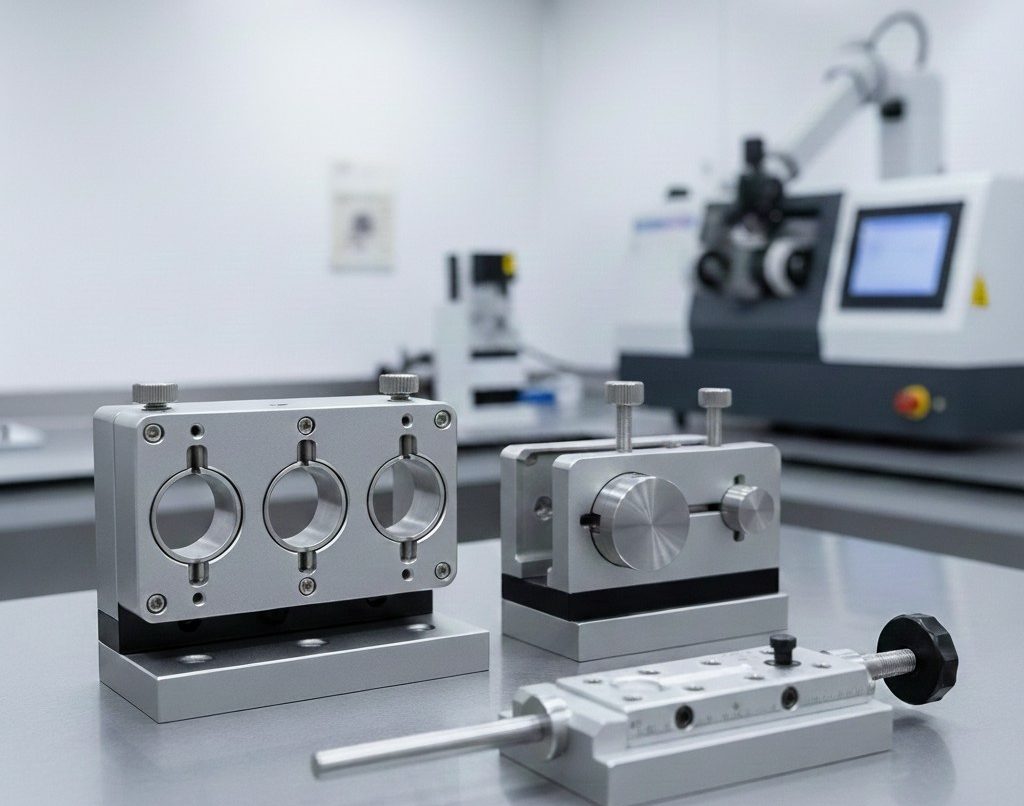
This is where metallographic sample preparation jigs and fixtures come into play. These mechanical support tools provide the stability, precision, and repeatability needed to eliminate human variability. Whether you’re preparing metallic alloys, coatings, AM components, or delicate thin films, fixtures ensure every sample begins with the same orientation, receives the same pressure, and maintains the same geometry throughout the process.
As a leading US distributor of metallographic tools and precision preparation systems, PSI Dragon helps labs overcome common challenges such as sample movement, edge rounding, uneven material removal, and inconsistent results.
What Are Metallographic Jigs & Fixtures?
Purpose of Jigs & Fixtures in Metallography
Metallographic jigs and fixtures stabilize the sample during grinding and polishing. Their role includes:
- Ensuring consistent pressure application
- Keeping orientation and alignment uniform
- Improving stability on both manual and automated prep systems
- Reducing operator-dependent variation
By controlling these variables mechanically rather than manually, fixtures transform sample prep from a “craft” into a repeatable process.
Types of Fixtures in Metallographic Prep
Common fixture types include:
- Sample holding jigs for general prep
- Multi-sample fixtures for throughput and even pressure distribution
- Alignment fixtures for orientation consistency
- Thin-sample clamps for fragile or film-coated materials
- Anti-rotation and anti-shift fixtures for stability on rotating platens
- Shim-supported systems for edge retention when sample geometry is critical
Each one addresses specific stability or orientation challenges.
How Fixtures Impact Repeatability
Repeatable metallographic sample prep requires each mounting, grinding, and polishing cycle to produce consistent results with minimal variation. Well-designed fixtures make this possible by ensuring identical load paths, restricting unwanted movement, maintaining precise geometry, and promoting predictable wear. Without fixtures, manual positioning introduces variability that labs cannot control.
Core Problems in Metallographic Prep That Fixtures Solve
Overview
Sample Movement During Polishing
Radial shifting leads to uneven surfaces and non-uniform removal rates. Fixtures lock samples in place to avoid catastrophic drift.
Edge Rounding on Delicate or Thin Samples
Gaps in resin or unstable mounts cause the edges to break down. Proper fixtures support edges mechanically to maintain geometry.
Uneven Force Distribution → Conical or Tilted Surfaces
Small samples in large mounts are extremely vulnerable to tilt. Balanced fixtures correct force distribution automatically.
Differential Grinding Due to Material Mismatch
If resin is softer than the sample, dish-out or relief occurs. Fixture rigidity helps equalize the forces involved.
Poor Sample Orientation During Grinding Direction Changes
Grinding “with” vs. “into” the substrate dictates damage levels. Orientation fixtures ensure the angle is correct every time.
Instability in Automated Polishing Systems
Automated systems require perfect alignment. Fixtures keep the sample flat and balanced during high-load operations.
Designing Effective Metallographic Jigs & Fixtures
Design Principles for Repeatable Metallographic Sample Preparation
Effective fixture design requires:
- Precise clamping and positioning
- Even force distribution
- Anti-rotation features
- High stiffness and dimensional stability
- Elimination of resin voids
All design choices must contribute to consistent load paths and stable geometry.
Material Selection for Fixtures
Common fixture materials include:
- Hardened steel for maximum rigidity
- Composite or polymer materials for chemical resistance
- Carbide inserts for wear resistance
- Shim-supported inserts for edge-critical applications
Material selection must align with the hardness and sensitivity of the sample.
Sample Size Considerations
Fixtures must adapt to:
- Small samples requiring stabilization
- Thin or fragile materials prone to bending
- Multi-sample setups for higher throughput
Ergonomic design improves handling and accuracy.
Pressure & Contact Engineering
Good fixtures:
- Maintain uniform load
- Reduce tilt to establish pre-planarity
- Prevent micro-chatter
- Improve contact stability on automated polishers
Orientation and Alignment Features
Look for:
- Angle guides
- Rotation locks
- Grinding-direction markers
- Automated system alignment compatibility
These additions help standardize prep techniques across operators.
Preventing Common Preparation Defects Through Better Fixture Design
How to Stop Edge Rounding with Proper Jigs
Using:
- Companion edge pieces
- Shim or razor-blade supports
- Hard-resin alignment tools
…keeps edges sharp and intact.
Why Small Samples Polish Unevenly & How Fixtures Solve It
Uneven polishing results from differential pressure. Fixtures counter this by:
- Redistributing load
- Using multi-sample carriers
- Stabilizing tiny specimens
Preventing Movement During Grinding & Polishing
Movement can be eliminated using:
- Anti-slip clamps
- Radial movement locks
- Support rings for balanced pressure
Maintaining Precise Alignment in Automated Polishing Systems
Best practices include:
- Flatness control
- Adaptive pressure distribution
- Anti-drift architecture
Advanced Fixture Designs for Modern Metallography
Fixtures for Thin-Film and Coating Analysis
Thin-film and coated samples require fixtures that protect brittle surfaces, prevent delamination, and allow accurate re-mounting without damaging the coating.
Fixtures for Multi-Layer, AM, and Nano-Structured Materials
Advanced materials benefit from fixtures that provide controlled backing support, minimize relief formation, and use coating-friendly inserts—such as electroless nickel—to maintain layer integrity during polishing.
Fixtures for Multi-Stage Preparation Workflows
Multi-stage preparation is best supported by modular fixtures that enable stable re-mounting and combine mechanical clamping with resin backing when enhanced support or edge retention is needed.
Practical Engineering Guidelines
Checklist for Designing an Effective Fixture
- Eliminates radial movement
- Supports all edges uniformly
- Achieves perfect pre-planarity
- Distributes load symmetrically
- Matches sample hardness
- Fits the polishing system
Recommended Tools
- Sample alignment carriers
- Precision clamps
- Multi-sample holders
- Anti-rotation plates
- High-flatness backing plates
When to Use Standard Fixtures vs. Custom Fixtures
Standard Fixtures
Best for:
- Routine QA
- Uniform samples
- Automation
Custom Fixtures
Required for:
- Edge-critical samples
- AM or coated surfaces
- Ultra-small or thin materials
- Complex microstructures
Choosing the Right Metallographic Fixtures for Your Lab
Key Evaluation Factors
- Equipment compatibility
- Hardness matching
- Sample-size flexibility
- Ease of maintenance
- Dimensional stability
When to Upgrade
- Planarity issues
- Edge rounding
- Low reproducibility
- Automation requirements
FAQ: Metallographic Jigs & Fixtures
Q: What jig is best for small or fragile samples?
A: Multi-sample carriers or thin-sample clamps.
Q: How do fixtures prevent edge rounding?
A: By providing mechanical backing and eliminating resin gaps.
Q: Should fixture material match sample hardness?
A: It should be close enough to avoid relief formation.
Q: Why does alignment matter in automated systems?
A: Misalignment creates tilt and produces inconsistent removal rates.
Q: How do I improve repeatability?
A: Use rigid fixtures, maintain consistent loading, and eliminate tilt.
Expert Insights from Industry Discussions
- Pre-planarity improves reproducibility.
- Support rings distribute pressure more evenly.
- Hardened shims protect sensitive edges.
- Grinding direction directly influences damage.
- FIB milling may outperform mechanical prep for ultra-thin films.
- Vacuum epoxy mounting increases stability and reduces voids.
Precision Fixtures = Repeatable Results
In modern metallography, precision fixtures aren’t optional—they’re essential. From eliminating radial movement to preventing edge rounding and achieving uniform pressure distribution, the right fixture design ensures every sample is prepared consistently and accurately. For QC labs, R&D teams, aerospace manufacturers, automotive suppliers, and advanced materials specialists, the path to reliable results starts with engineering-grade jigs and fixtures.
Looking to improve consistency, throughput, or precision in your metallographic prep? PSI Dragon supplies high-performance jigs, fixtures, and microabrasive systems trusted by engineers and laboratories across the United States. Explore advanced solutions or request expert guidance today.